GASG is delighted to announce that 3 new members have recently joined the Group.
(March 2026)
Dynament, a long standing UK manufacturer of optical gas sensors has been operating for over 20 years and is based in Mansfield, Nottinghamshire. They offer a wide range of nondispersive infrared (NDIR) gas sensors for monitoring hydrocarbons, carbon dioxide, nitrous oxide, and refrigerant gases. Their patented IR technology is integrated into OEM gas detection products all over the world .
We also have a new Corporate member. The National Physical Laboratory is the United Kingdom’s national metrology institute, developing and maintaining the country’s primary measurement standards and delivering the world‑class measurement capabilities that underpin the UK’s prosperity, scientific progress, and quality of life. Through its research and expertise, NPL helps drive innovation and product development across industry, ensuring the accuracy and reliability needed for cutting‑edge technologies and high‑value manufacturing. Founded in 1900 and headquartered in Teddington, NPL also operates regional sites in Huddersfield, Glasgow, Cambridge, and Guildford, extending its measurement science and innovation activities across the UK.
Most recently, we have been joined by Protea, a UK manufacturer of analysers using a range of technologies including IR, UV, FTIR, TDL and QMS, operating from sites in Middlewich and Peterborough. The company has a particular expertise in stack and marine emissions, pollution reduction and process improvement and offers support for entire monitoring systems.
GASG warmly welcomes all 3 organisations!








 Attendees also benefitted from the insights provided by Prof Norman Ratcliffe (University of the West of England) who gave a highly entertaining plenary talk entitled ‘The Smell of Disease’, drawing on his long career in the field of gas detection for medical diagnosis.
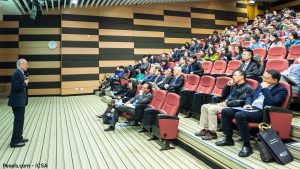


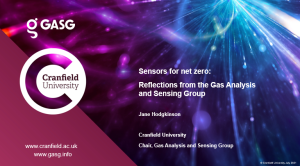 Jane focussed on the significant and highly relevant activities in gas, VOC and particulate sensing which GASG promotes through our meetings and publications. It was emphasised that mainstream gas sensing has long supported the petrochemical sector, having grown with the rise of fossil fuel extraction and use. The sensing industry is now an important driver, monitor and enabler of the path to net zero. The need to dramatically reduce emissions is widely accepted, but some leakage is inevitable and the various risks associated with a wide range of gases must still be mitigated. This is driving significant increases in sensor deployment (and lowering of costs), improvements in limits of detection and growth in emissions measurement applications across all sectors, not just oil & gas. Even in a fully electrified world, there will still be many applications for gas and particle sensors!